
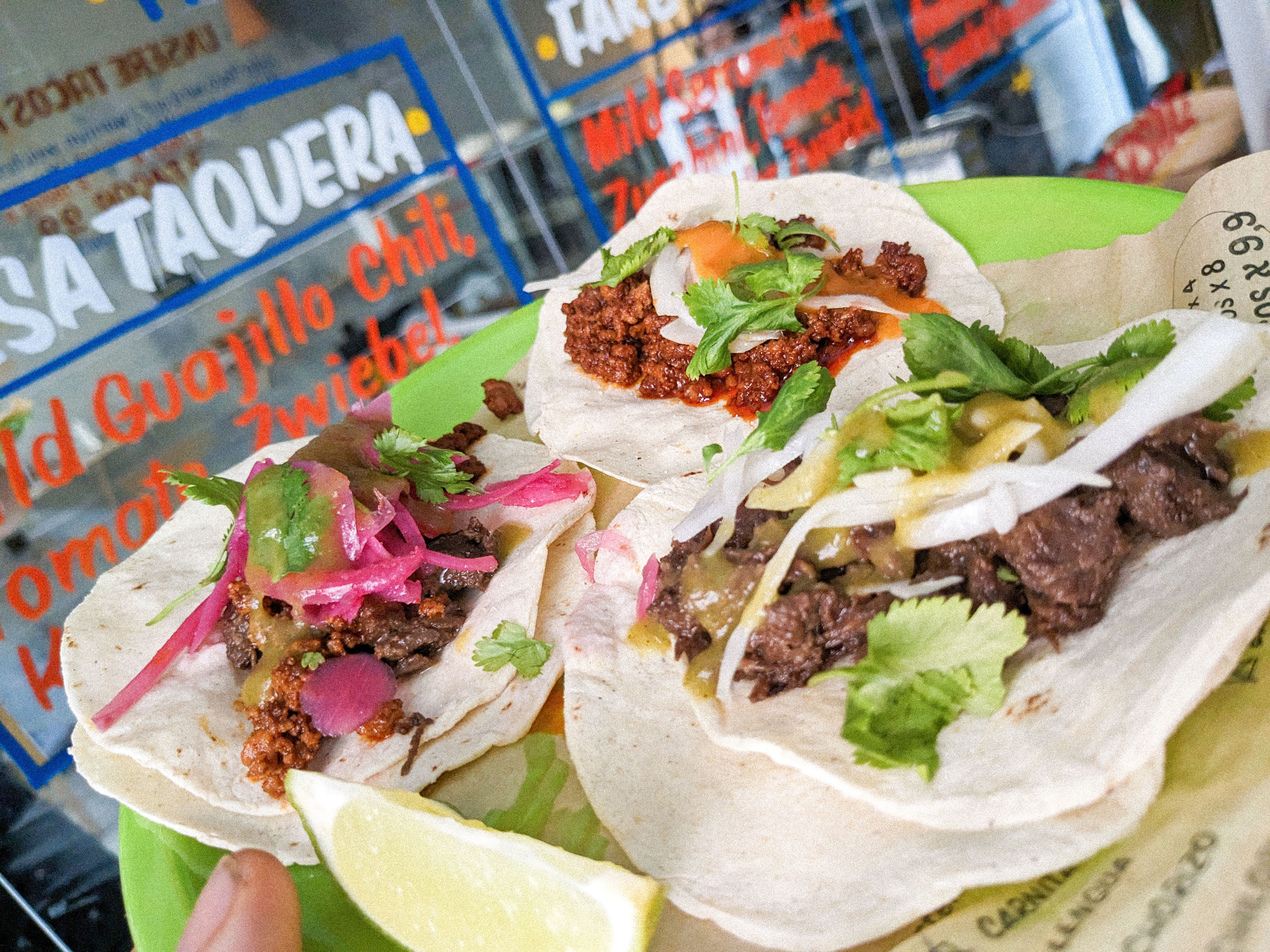
Outside Mexico, “street taco” often sounds like a menu category. In Mexico, the reality is much messier - and much better.
There is no single official street-taco recipe, size, meat or topping. What people recognize as Mexican street-taco culture comes from the relationship between the tortilla, a specific preparation, salsa, speed, specialization and the social space of the taqueria or street stand.
That is the important part. A street taco is not authentic because someone wrote street style on a menu. It feels convincing when the food and the way of eating it make cultural sense together.
“Street taco” is a useful label, not a single Mexican recipe
Mexico has an enormous taco vocabulary. Pastor is not carnitas. Carnitas are not barbacoa. Barbacoa is not birria. Suadero, lengua, cabeza, pescado and countless regional tacos each have their own techniques, histories and contexts.
So when English-language menus use the phrase “street taco,” they are grouping together something that is far more varied on the ground.
What often connects those tacos is format: food made to be eaten immediately, often from a specialist stand or taqueria, with tortillas warmed to order and salsas or garnishes that finish the taco rather than bury it.
The exact details change from place to place. That variety is not a problem to solve. It is the culture.
What makes taquería culture feel convincing
Warm, fresh and appropriate to the taco.
A clear taco style or specialty, not a generic filling.
Part of the flavor system, not decoration.
Fast, direct, social service with little distance between food and diner.
The taqueria is part kitchen, part choreography
Watch a busy taqueria and the first thing you notice is movement.
One person handles tortillas. Someone works the plancha. A taquero slices from the trompo or chops meat on the block. Orders are called out quickly. Salsa arrives. Limes disappear. A plate lands in front of you and, before long, the question is no longer whether you want another taco but how many.
The choreography is practical, but it also creates atmosphere. You see the food being made. You smell it before you taste it. You hear the chopping, sizzling and conversation. The distance between kitchen and diner is short.
Food historian Jeffrey M. Pilcher has described how taquerias became part of working-class urban neighborhoods and how migration into Mexico City helped bring regional cooking traditions together. That history helps explain something you can still feel today: taco culture is deeply social and deeply urban, but never uniform.
Specialization is a feature, not a limitation
A very Mexican food lesson is that a place does not need to serve everything to be worth visiting.
Some of the most memorable food businesses are known for doing one preparation again and again until the process becomes muscle memory. In taco culture, specialization can mean a whole stand built around pastor, barbacoa, carnitas or another style.
That creates a different expectation from the giant international “Mexican restaurant” menu where tacos, burritos, nachos, fajitas and ten unrelated dishes all sit beside one another.
A taqueria can be small and still contain a lot of knowledge.
The tortilla is not a disposable wrapper
If the tortilla is cold, dry or fighting the filling, the taco is already in trouble.
The tortilla controls the first aroma, the texture of the bite, how much filling the taco can hold and whether it folds without breaking. Corn tortillas are central to many taco traditions; flour tortillas also have deep roots in parts of northern Mexico. There is no need to turn one into a moral test for the other.
What matters is that the tortilla makes sense for the taco being served.
That is why our separate guide to taco vs. tortilla goes deeper into masa, nixtamalization and the difference between the tortilla and the taco itself.
Salsa is a decision, not decoration
A taco without salsa can still be a taco. But in taqueria culture, salsa is rarely an afterthought.
Different salsas change heat, acidity, sweetness, smoke and texture. The right one can sharpen a rich filling; the wrong amount can flatten everything under pure heat.
And no, the goal is not always to choose the hottest salsa available. The flex is not suffering. The goal is making the taco taste better.
This is one of the easiest ways to spot the difference between taco knowledge and Mexican-themed decoration: does the place treat salsa as part of the food system, or merely as a red bottle on the table?
“Authentic” should describe knowledge, not nostalgia
Authenticity is a useful word only when it has content behind it.
A Mexican taqueria does not become more authentic by collecting stereotypes. Sombreros, cacti and bright colors cannot replace knowing the difference between regional taco styles, understanding tortillas, respecting preparation methods or knowing how a salsa is supposed to function.
At the same time, authenticity does not mean freezing Mexican food in the past. Some of Mexico’s most iconic foods are the result of migration and adaptation. Tacos al pastor are a perfect example: the vertical-spit technique is tied to Middle Eastern migration, then transformed in Mexico into something unmistakably Mexican.
That is why taco culture is more interesting than purity tests. It has roots, but it also moves.
What does any of this mean in Vienna?
La Taquería Chiquitita exists in Vienna, not Mexico, so the goal is not to build a theme park version of a Mexican street corner.
The job is more demanding: bring the taqueria logic with enough knowledge that it still feels credible in another city. Product first. Tortilla, filling and salsa in balance. Color and humor without caricature. Informality without indifference. Mexican culture treated as culture, not costume.
Today there are two La Taquería Chiquitita locations in Vienna. The easiest way to understand the idea is still the simplest one: come eat tacos and pay attention to the whole ritual, not just the filling.
You can check the current menu here.
Kurz erklärt: Was bedeutet Taquería-Kultur?
Was sind Mexican Street Tacos?
“Street Tacos” ist keine einzige festgelegte Taco-Sorte. Der Begriff beschreibt außerhalb Mexikos meist Tacos, wie man sie mit Straßenständen und Taquerías verbindet: frisch zubereitete Tortillas, eine konkrete Füllung, Salsa und direktes Essen ohne viel Zeremonie.
Was ist eine Taquería?
Eine Taquería ist ein auf Tacos spezialisiertes Lokal oder ein Taco-Stand. Viele Taquerías konzentrieren sich auf bestimmte Zubereitungen statt auf eine riesige Speisekarte.
Woran erkennt man einen guten Taco?
Nicht an einer festen Zutatenliste. Achte darauf, ob Tortilla, Füllung und Salsa zusammen funktionieren, ob die Zubereitung klar erkennbar ist und ob der Taco frisch serviert wird.
Muss ein authentischer Taco immer gleich aussehen?
Nein. Mexiko hat viele regionale Taco-Traditionen. Authentizität bedeutet nicht Einheitlichkeit, sondern Wissen, Technik und kulturellen Kontext.


